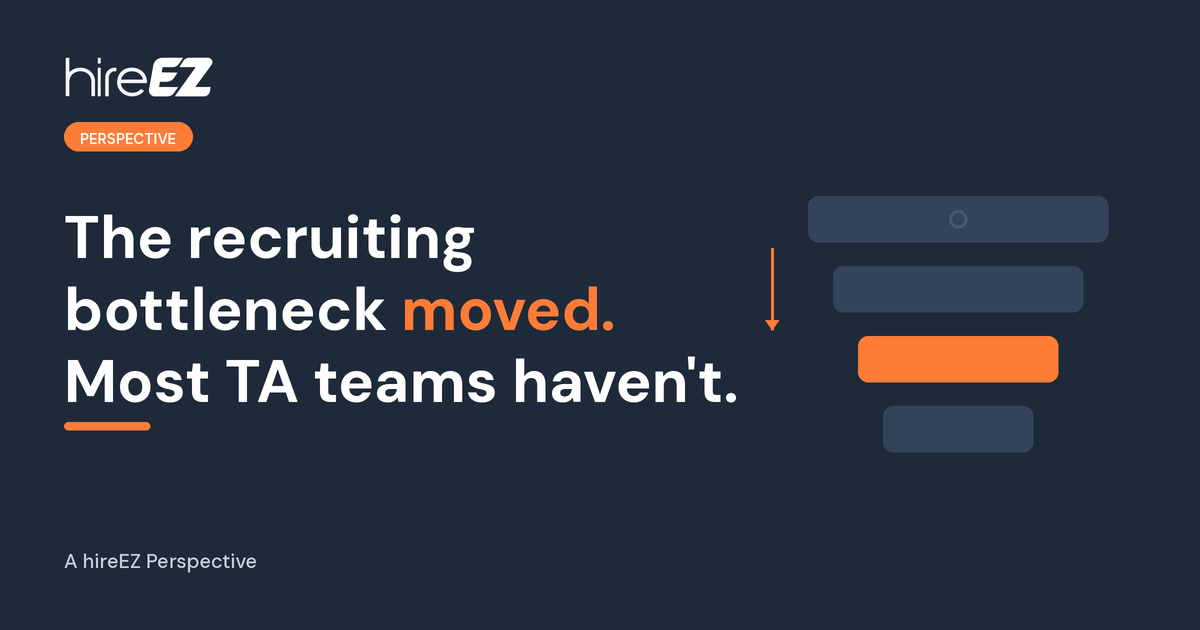


For ten years, we optimized the wrong end of the funnel. We poured budget and headcount into sourcing, because finding people was hard. It isn't anymore. AI now surfaces qualified candidates across dozens of channels in minutes, and the teams still treating sourcing as their core constraint are solving a problem the market already solved.
The bottleneck moved. It is sitting between "this candidate is qualified" and "this candidate is on a hiring manager's calendar." And almost no TA function has restructured around that fact.
We optimized supply while demand quietly broke
Application volumes are up more than 50% since 2020. TA headcount is flat or shrinking. So the constraint didn't disappear. It slid downstream, into the handoff between screening and the interview.
That handoff is mostly manual coordination: aligning recruiter, candidate, hiring manager, and panel across calendars and time zones, then chasing reschedules over email. It produces no dashboard, no metric, no line item. It is the most expensive invisible work in recruiting, and it is where strong candidates go cold while a faster competitor closes them.
Here is the uncomfortable part. Most of us have known this and filed it under "ops annoyance" rather than "strategic problem." It is not an annoyance. It is a revenue leak.
The C-suite already sees a number you can't explain
Your CFO doesn't think about time-to-fill. They think about output that didn't happen because a seat was empty. An unfilled clinical role is a closed bed. An open sales seat is a quota nobody carried. A vacant engineering role is a roadmap that slipped.
The math is simple and brutal. Unfilled days multiplied by the revenue impact of the role equals revenue at risk. Every week the apply-to-interview gap adds to time-to-fill, that number grows, and right now no one in your function is putting it in front of leadership.
This is the reframe that changes how TA gets funded. Stop walking into reviews saying "we filled 47 roles." Start saying "we protected revenue by cutting time-to-fill on critical roles." Teams that close the gap see numbers like these:
Those aren't efficiency stats. They are the language of a revenue function, and they are how a TA leader stops defending a budget and starts claiming a seat at the revenue table.
Buying a scheduling tool makes the problem worse
The instinct, when scheduling is the bottleneck, is to buy a scheduling tool. Resist it. It is the wrong move, and the C-suite will read it as the wrong move.
You almost certainly already run 5 to 10 disconnected recruiting tools: a sourcing tool, a CRM, a screening add-on, an analytics dashboard. Half of all TA teams are planning to cut that sprawl this year, because leadership is finally asking why they are paying for ten things that don't talk to each other. Bolting on an eleventh, an "AI scheduler," adds another login, another silo, and another integration to the exact problem you have been told to shrink. If anything, the smarter project is the opposite one: consolidating the stack you already have.
There is a deeper reason it fails. A standalone scheduler doesn't know who just passed the screen, so it can't act the moment it matters. The value isn't in the scheduling feature. It is in scheduling firing automatically off the screen result, from the same system that did the screening. Disconnected, it is just one more tool that makes you feel busy.
This is the pattern every category eventually follows
We have all seen this movie. Every enterprise category moves through the same three acts.
Sales lived it: a database of contacts surrounded by a dozen tools, until execution consolidated onto one layer. Marketing lived it. TA is next, and it is overdue.
Your ATS is the system of record. It is a filing cabinet. It stores what happened, and it was never built to act. The 5 to 10 tools stacked on top of it are collapsing into a single intelligent execution layer, an agentic AI recruiting platform that sources, screens, schedules, and reports on top of the ATS you already run, with no rip-and-replace, deployed in weeks. Scheduling stops being a tool you buy and becomes one connected action inside that layer: zero manual coordination, minutes from screen to scheduled interview. And because it all runs in one place, you finally get recruiting analytics that tie time-to-fill back to revenue.
What the next 12 months will demand of you
Two forces are converging, and they will separate the leaders from the laggards.
First, budget scrutiny is intensifying. In every planning cycle now, the C-suite wants proof of ROI on each tool. "We have an AI scheduler" is not proof. "We compressed time-to-fill and protected revenue, on fewer tools" is.
Second, agentic AI has matured from demo to production. The skepticism TA leaders rightly built up, after years of chatbots and isolated AI screens that didn't connect to anything, is finally being answered by workflows that actually run end to end. The teams that adopt the execution layer now will spend the next budget cycle showing revenue impact. The teams still stitching point solutions together will spend it defending line items.
The question isn't whether scheduling matters. It is whether you are going to keep treating the symptom or fix the system. The bottleneck already moved. Move with it.
If you can't yet say what your open roles are costing the business, start there. Read the report, then run your own reqs through the calculator.
Get: The Revenue Cost of Unfilled Roles


